

MAKING SMART
CONSTRUCTION
BRILLIANT™
Autovol is pioneering new solutions to the affordable housing crisis.
MAKING SMART CONSTRUCTION BRILLIANT™
Join our team of Solutioneers™
Join our team of Solutioneers™
Explosive housing demand and severe labor shortages have created a housing crisis. Autovol has pioneered a now-proven solution. Our first-of-its-kind factory brings together the best practices of modular construction and automation. Solutioneers practice the trades with pride and joy, adding robots as tools to supercharge speed, precision, and output. Communities get a thriving new source of top quality housing. Add it all up. We think we’re onto something.

A Top Workplace 4 years running and ranked #1 in 2023 and 2024

Top awards for innovation, permanent buildings, and marketing
America’s top-producing multifamily modular plant, by the numbers
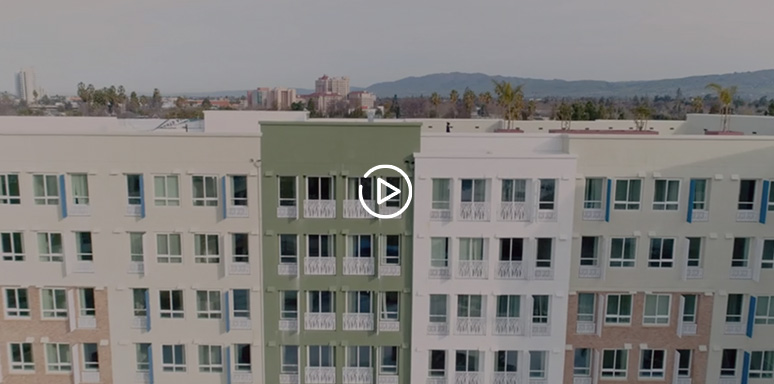
See the journey of Autovol’s 100th module. This journey begins at the end, with a twist you won’t expect. Wait for it!
Where most companies refer to their people as laborers, workers, employees, or human capital, we prefer an identity that elevates who we are. We identify as Solutioneers: part engineer, part pioneer, and all-around finder of solutions. It’s a positive, empowering, and fitting name for our special family. We even have a formal Solutioneer definition.
Yes. Autovol, Inc., is a privately owned corporation. It was started with a private investment of $104 million in 2018.
Rick Murdock, Caleb Roope, and Curtis Fletcher co-founded Autovol in 2018.
We have built millions of square feet of living space and thousands of apartment units. We show key production stats on our website homepage. These are updated at the beginning of each month. Autovol is America’s top-producing manufacturer of multifamily modular housing.
We use very high quality materials, and build with all the advantages of an advanced automated factory. Our work has received multiple awards and we hear frequent comments about its quality. In fact, after supervising his first project with Autovol, the contractor who built the personal residence of Tim Cook, Apple’s CEO, said the fit and finish quality of Autovol’s living units was better than what he was able to achieve in Cook’s home.
Autovol began with 63 robots. As we innovate and evolve, that number fluctuates.
We don’t know how our robots feel about our Solutioneers. But our Solutioneers are quite happy using robots as tools. We’ve prioritized the heavy lifting and repetitive tasks to robots and automation. This helps reduce injury, wear-and-tear on the body, boredom, and errors from fatigue. It also liberates our Solutioneers to focus on making the culture more enjoyable for all.
While some of our transport and onsite services Solutioneers work outdoors, most Solutioneers work indoors their entire workday. Our facility is kept at a very comfortable temperature range, and Solutioneers are often seen in shorts even during the winter months.
While we do look for the most skilled and experienced workers for many roles, we hire for character over pedigree. We believe it’s easier to hire the right person and train them than hire the wrong person who’s already trained. Solutioneers become experts in their stations. Because they come to the same worksite and use the same basic equipment each day, Autovol is an ideal environment for Solutioneers to teach and learn multiple skillsets. As we lead the way in game-changing construction practices, we encourage Solutioneers to “train their replacement” and be ready to advance in their careers.
In many ways, Autovol is an ideal training ground for construction and manufacturing best practices. By encouraging Solutioneers to train their replacement, we have seen a number of Solutioneers train new Solutioneers for their stations, then advance to new stations or our new shift. We have supported electrical Solutioneers by providing the needed schooling to gain electrician licensing.
As of April, 2026, the total staff is nearly 270. Our Monday through Thursday Shift 1 had about 200 Solutioneers, and our Friday through Sunday Shift 2 had more than 70. On top of this, we have about 130 temps and subcontractors—with about 90 on Shift 1 and 40 on Shift 2. Our subcontractor team includes dedicated tradespeople from Inman and Sons, Advanced Heating and Cooling, Advanced Drywall, and Stack Rock. So, total people in the building for Shift 1 is about 290, and total for Shift 2 is about 100.
Autovol’s Solutioneer age range currently spans 18 to 73 years. Our minimum age is 18, and we have no maximum age limit. Maybe someday we’ll have a centenarian!
Up to this point, we have had a very small number of interns at Autovol. These have been on a case by case basis. We currently have no formal internship program.
We don’t think so. And we’re not just saying that. The number of tradespeople needed in construction has been growing far faster than the number of skilled people who are coming into the workforce. We set out to add automation and robotics because of this lack. Robots take on heavy lifting and repetitive tasks, elevating our Solutioneers to focus on more satisfying and intellectually challenging work. Robots aren’t replacements. Faced with a housing-shortage, they’re the newest tools designed to help us catch up.
Currently, most of our completed projects are in California. Our plant is situated in an ideal location to serve most of the Western United States and parts of Canada. We prefer to deliver to locations within an 800-900 mile radius from Nampa, Idaho. We are discussing projects in a variety of states and provinces within this radius. Browse our map of completed projects.
Our factory is very busy with lots of machines and people moving quickly, often in very tight spaces. Our constant focus is on producing more housing to provide addresses for people challenged by the current housing crisis. While we love showing off what we do each day, we must be very selective in reviewing and accepting any requests for tours. We do occasional small-group student tours by special request.
Our controlled environment optimizes material use to reduce waste and recycle nearly everything. As Solutioneers, we run on the lean manufacturing model and the five S’s (sort, set in order, shine, standardize, sustain). Most of the minimal waste we do encounter is recycled. We recycle steel, HVAC ducting, wiring, cabling, flex, copper line, and scrap lumber. We have also donated excess building materials. The Modular Building Institute at Modular.org has compiled good data about modular construction
Not at this time. We focus on multifamily complexes: primarily apartment buildings, workforce housing, and hospitality projects.
Autovol has a rich chain of materials suppliers, providing everything from lumber to appliances. We strive to use supply chain best practices, and work closely with our suppliers to instill our Solutioneer mindset into their practices. Because we build in new ways, our materials suppliers can take advantage of new ways of supplying materials— building the material around the capabilities of equipment. Our supply chain is helping redefine precision and productivity to advance construction and manufacturing.
We are a company that includes two main industries: construction and manufacturing. We construct modules. These are fully-finished living units, which are our finished product. For each project we produce for a developer customer, we deliver a set of modules that are then assembled into one or more apartment buildings or hotels. The building assembly and completion are overseen by a general contractor working onsite for the developer. We provide an onsite services team so that the general contractor has an Autovol expert available to advise and assist while the building is being completed.
We have supplied a number of developers with modules for their projects in the western US. To date, the majority of these projects have been for The Pacific Companies, one of America’s top producers of affordable housing. Our customer base continues to broaden, and we have served on several projects that were first-time projects for the developers and general contractors involved. Our website’s Projects page outlines our projects and lists the developer of each.
To date, we have one factory, at our company headquarters in Nampa, Idaho. As we have successfully completed many projects since 2020, demand has continued to grow. We recently augmented our team of Solutioneers by adding a second shift. First- and second-shift teams work on the same projects. As we continue to meet growing demand, we may consider a second factory at some point. Two of our co-founders have dedicated a separate company, Waypaver© International, that consults to factory startups across the US and beyond. A number of such factories are in progress.
Width: Maximum—15 ft. 4 in., including firewalls. Minimum—10 ft. 0 in.
Length: Maximum—74 ft. 0 in. Minimum—15 ft. 0 in.
Height: 11 ft. 6 in. with 8 ft. interior ceiling (10 ft. floor-to-floor height); 12 ft. 6 in. with 9 ft. interior ceiling (11 ft. floor-to-floor height); 13 ft. 6 in. with 10 ft. interior ceiling (12 ft. floor-to-floor height)
Maximum—12 ft. 6 in. Note: our typical module height is 11 ft floor to floor, allowing for 9 ft. interior ceilings
Yes, we can build projects at 9 ft. 11 in. floor-to-floor. This translates to 8 ft. 0 in. interior ceilings. Soffit and dropped ceiling builddowns will be lower than 8 ft. 0 in.
We can build a project with ceiling height up to 10 ft. 0-1/2 in. The ceiling height can be 10 ft. on level 1 and 9 ft. on the upper levels.
By standardizing, we save our customers money and time, while avoiding supply issues and design uncertainties. While we may consider and discuss special requests or allow for them by your final site crew, these are our standard specified materials and finishes:
Interior paint: SW7012 Creamy on walls, ceilings, doors, millwork—eggshell sheen
Max window opening: 8 ft. wide by 7 ft. 6 in. tall
Floor coverings: Carpet, Karndean LVT, ceramic tile
Showers: We can provide and install tile showers
Natural Gas: Gas stoves and/or dryers are evaluated on a case-by-case basis CSST flex pipe only—no black piping
Stairs: We can build U-shaped, L-shaped, or straight-run stairways
Pocket Doors: Barn doors are preferred due to cost and durability—our robotics can’t frame pocket doors
The preferred method is to have chases throughout the Corridor to simplify MEP routing and connections. Thickened corridor walls for MEP routing and connections pose challenges in that corridor rims need to be cut so that connections can be made and then a structural connection will need to be done afterwards for shear integrity. Projects with such deviations may be evaluated on a case-by-case basis.
All doghouses and roof overbuilds are part of onsite GC scope.
The Autovol office building is more than 30,000 feet. The Autovol manufacturing floor is more than 400,000 square feet. The two buildings are connected by common areas that encourage all our Solutioneers to mingle as one team.
Autovol is located in Nampa Idaho near Idaho Center Boulevard. Our site was purchased from a retiring farm family. In fact, we broke ground just after the family’s final corn crop had been harvested. With help from Sargent Metal Works, we carefully repurposed things found on the site into elements of our office: Our front desk was originally a hay rake. Our main conference room table is made from a former 1932 Hudson automobile chassis. Our front office is accentuated throughout with trim from barnwood.
There are too many interesting things to list! The 400,000+ square-foot-floor equals more than 7 football fields (including end zones!) One thing unique about our factory floor is a fleet of three-wheel electric scooters that save our Solutioneers millions of steps. The factory is really two operations in one: the panel area where floors, ceilings, and walls are built by robots; and the 45+ stations where our Solutioneers turn panels into fully finished apartments complete with flooring, plumbing, wiring, paint, cabinets, appliances, and much more. It’s an advanced manufacturing floor and bustling construction site—all in one.
When someone is hired as an Autovol Solutioneer, we give them an optional intake form to get to know them as individuals. One of those things is their birth country. Another is military service. Based on these, we’ve hung flags for country of origin and branch of US armed services. Autovol has a very large US flag hanging in the center of the factory. Because we have helped advanced construction as a US manufacturer in a history-making way, we acknowledge that with the flag, and also with our company colors of red, white, and blue.
Robots were named at our first annual summer Shindig, during a Name Your Robot game for kids. It turns out the robot names help out in knowing and communicating about them to keep work flowing. If “Bigfoot” needs troubleshooting, one Solutioneer can say to another, “Bigfoot is down.” Also, by naming the robots, we incorporate them into the team.
The strongest robot in our factory is Stacie on the floor/ceiling automation line. She’s our main element transfer robot, and the largest robot we have. Stacie is built to handle the heaviest loads. Stacie’s job is to lift and transfer finished sub elements, then precisely place them into the main structural elements, such as floor and ceiling frames. Stacie plays a critical role in keeping production moving efficiently.
Our busiest robots are the fastening robots that use nail tools: Richard, Elsa, Thor, and Tobor. They work in the wall sheathing system, where there are four tools at the end of each robot arm, with five nail guns each. These robots are constantly in motion, fastening sheathing throughout the entire production process. Each wall, floor, and ceiling frame receives hundreds of nails as it’s being sheathed. So these robots handle a massive amount of repetitive, high-speed, precision work, relieving our Solutioneers of a major physical burden.
Our robots are actually pretty low maintenance overall. Most of them just require routine inspections and basic upkeep. The only systems that need more regular attention are the adhesive robots and the screw tools. The adhesive robots require more frequent servicing because the adhesive (glue) can sometimes build up on the nozzles, which can get bent. We also regularly check the adhesive barrels to make sure they don’t run low. The screw tools require maintenance due to normal wear and tear. To keep everything running smoothly, the drill bits are swapped out frequently.
We have roughly calculated that at our 4,000-module production milestone in 2025, we had transformed about 24 million board feet of lumber into fully finished apartments and hotel rooms. If placed end to end that would be about enough to span from Los Angeles, California to Washington, D.C. and back again!
We use nails, screws, and “scrails” (screw/nail hybrids)—which we call fasteners. To give an idea, let’s take our wall assembly line. It includes four stations: sub-element, sub-sub element, main element, and wall sheathing. Across all four automated stations, we average roughly 30,000 to 50,000 fasteners per day. The three stations responsible for building the wall frames each process between 5,000 and 8,000 fasteners per day. The wall sheathing station accounts for the majority, applying about 25,000 fasteners per day.
Your questions are welcomed. You can submit a question on our website’s Contact page. While some answers may be confidential, let’s start a conversation and see what we can learn together!
We hire Solutioneers in administration, facilities, modular construction, skilled trades, construction trades, engineering and IT, finance, operations, procurement, production, quality assurance, shipping and more.